Blog
A month of building a game site with Claude Code
How Claude and I built Unnecessary Obstacles, a shelf of family games, in a month, and the setup that let every session pick up where the last left off.
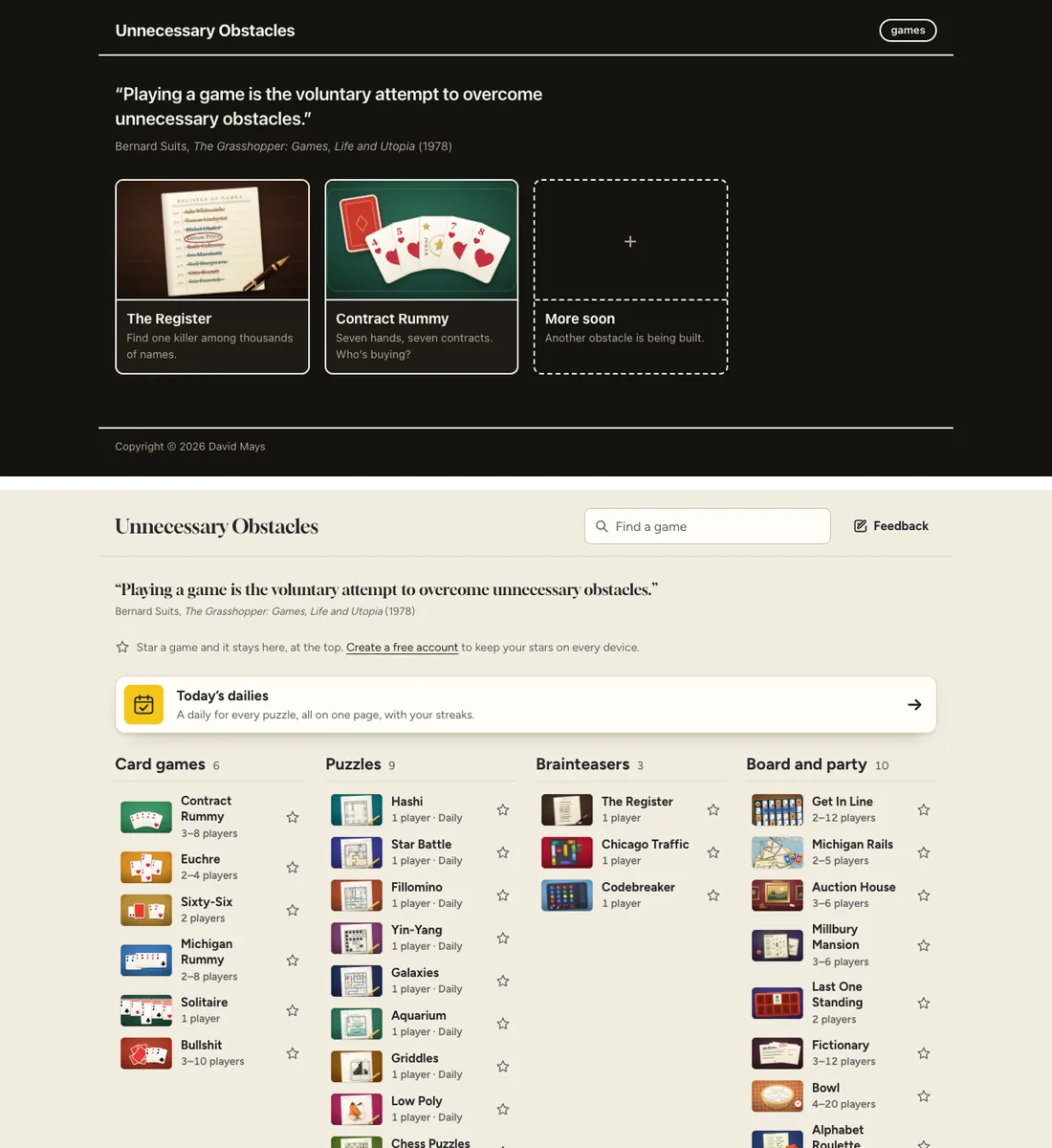
On October 6 I moved a murder-mystery game I’d made into a new website, and asked Claude to build my family’s favorite card game beside it, with our house rules. A month later the site has 28 games: card games, party games, logic puzzles and brainteasers, with live tables, bots, daily puzzles, ratings and a release every few days. I didn’t write most of the code. Claude did, in Claude Code, in sessions I started and steered. I brought the games, the rules, the calls, and a lot of playtesting with my family. The whole thing is built to “make and share games and puzzles I love, for free”.
This post is the short version. The long one, with the details, is a new part of the site’s technical guide, Built with Claude Code.
The problem: Claude forgets#
Every Claude session starts fresh. On a project this size, that’s the whole problem. The fix was to make the project remember instead: what the site is, every call I’ve made and why, how to check that it works, and what we’ve learned. Each new session reads that first, and starts out knowing more than the last one did.
What made it work#
One front door. AGENTS.md is the file every session reads first: a map of the code, numbered rules with the reason for each, and the exact commands.
Every call written down. A call made in chat and written nowhere gets asked again next week. So each one goes in a short decision record, dated, in my words. There are more than a hundred now.
Documentation that can’t drift. The site has a technical guide explaining every system from the code. Each chapter pulls its code snippets and numbers live from the source, names the code it covers, and carries a hash of it. When that code changes, a check fails until someone reads the chapter again. It’s the piece I’d keep if I could keep only one: every session learns the site from docs that match it.
One gate, and hooks. One command runs every check before a pull request. Claude Code hooks block a commit while the guide is stale, and a pull request until the gate has passed on that exact code. An instruction can be forgotten; a hook can’t.
Every bug fixed twice. Once in the code, and once in whatever let it through: a test, a check, a rule, a better default. After my family’s game nights, each lesson became a named design rule and a line in every new game’s checklist, so the next game couldn’t repeat it.
Skills. Anything I walked Claude through twice became a skill: shipping a release, making its video, building a new game, a round of playtest fixes, a design audit. Now each is one command. The skills chapter shows them, read live from their files.
What I learned#
- I pick the games. Early on I asked Claude for original game ideas. They worked, but they felt “a little bland and not that fun”. My family’s favorites are what made the site good, and Claude’s creativity went into making those good.
- Small batches. I kept running near my plan’s weekly limit, so work came in batches I could play the same evening. It turned out to be the better way anyway.
- Mind the machine. It all runs on one 8 GB laptop. After I ran too much at once and it ground to a halt, every plan got sized to it: two helper sessions at most, one server each, browser checks that wait while the machine is busy.
- Play it yourself. Tests prove the logic. Only my family at the table proved it felt right.
Try it yourself#
I wrote up the setup, generalized for any hobby project, as a starter kit: a personal CLAUDE.md to fill in, a /new-project skill that sets a project up in about twenty minutes, when to add each piece, and the phrases that get the most out of it. It started as something for my brother.
This blog arrives with version 2.0.0, the first release run from a plan by a lead Claude session that briefs and merges the others, with “More focus on delight as a design feature.” From here on, every release gets a post about how it went, starting with that one.
Written by me, with Claude.