Built with Claude Code
The story so far
How Claude and I worked out what an Unnecessary Obstacles game is, in a month: the ground rules I set at the start, the turning points that reshaped them, what we ruled out, a picture of every part arriving, and the site as it looked along the way.
I’m David Mays, and this site is mine and my family’s. I didn’t write most of its code: Claude did, working in Claude Code, Anthropic’s coding agent, in sessions I started and steered. I brought the games my family plays, our house rules, the calls on how things should look and feel, and a lot of playtesting. This part of the guide is how that worked, in my words, with Claude’s help writing it down.
This chapter is the story of what a UO game is: the ground rules I set at the start, how Claude and I each reshaped them, and what we decided a UO game is not. The next chapter is how we work day to day, then the skills we’ve written down, and last a starter kit for trying it yourself.
The quotes are mine, copied from what I typed to Claude at the time, and dated.
How it came together#
Each dot below is one part of the site, placed on the day it first arrived. Same-day dots stack, so a tall column is a busy day. The dashed lines are the numbered releases.
A script draws it from git alone, so it’s redrawn rather than kept up by hand. The same command redraws the numbers over time, at the end of this chapter:
npm run guide:timeline
It counts what’s in the tree today. A thing’s day is the day its oldest file was first committed, following renames, so a folder that moved keeps the day it began. The lanes are fixed in the script:
tools/guide/timeline.py lanes · lines 44–54# Each lane: its name, and what it counts, by path in the tree today.
LANES = (
("Games", "a game's own folder, games/static/games/<slug>/"),
("Kits", "the shared kits every game is drawn with"),
("Django apps", "a folder at the top with an apps.py"),
("Skills", ".claude/skills/<name>/"),
("Hooks and the gate", ".claude/hooks/*.sh and tools/check-pr.mjs"),
("Tools and checks", "a folder in tools/"),
("Decisions (ADRs)", "docs/adr/<number>-*.md"),
("Guide chapters", "a chapter in docs/guide/"),
)
The ground rules#
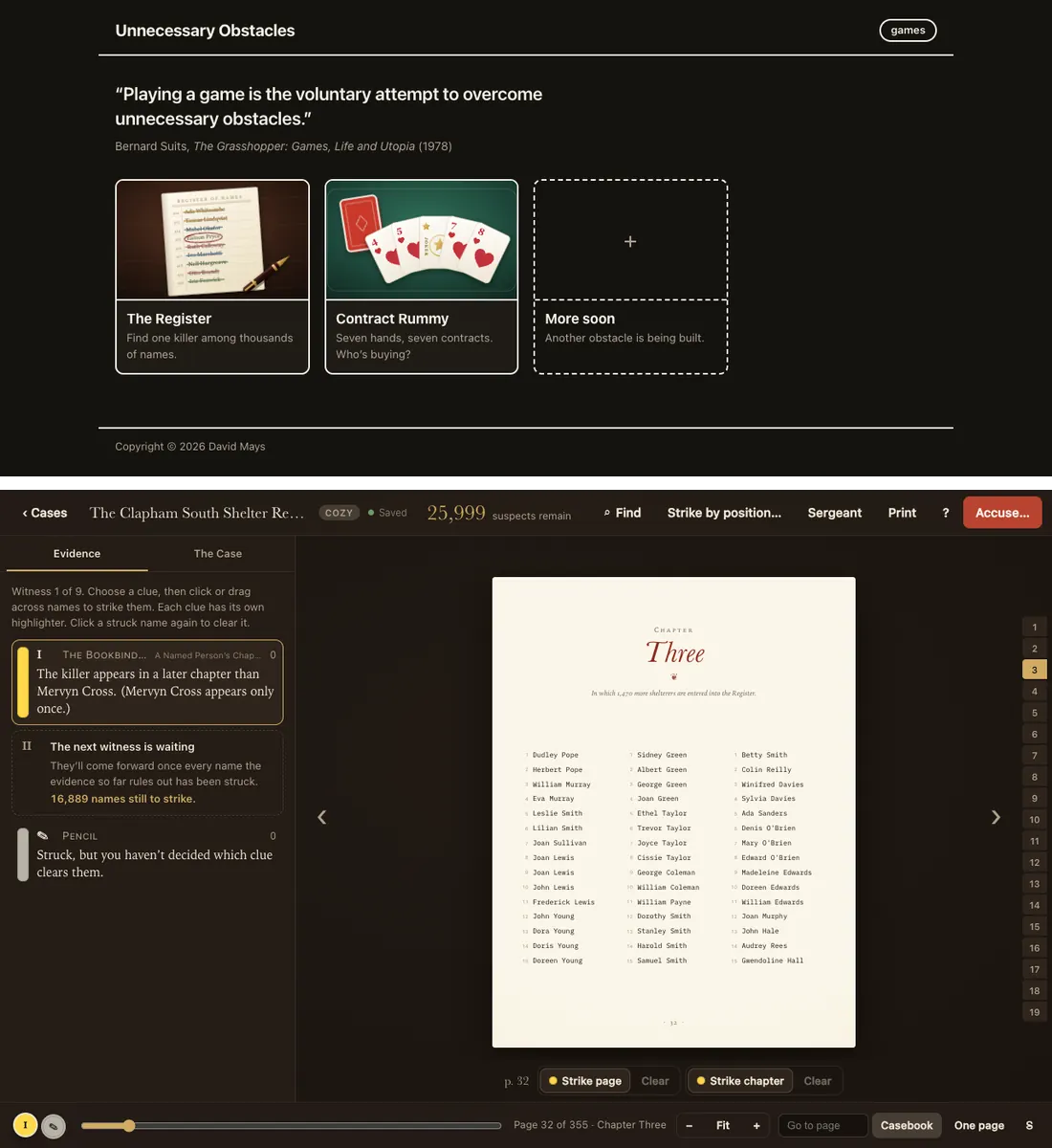
The name came first. Bernard Suits defined playing a game as the voluntary attempt to overcome unnecessary obstacles, “a definition I’ve always loved” (October 4). His words, attributed, sit at the top of the home page.
The first game was The Register, a murder mystery solved by deduction that I’d built on its own. On October 6 it moved into a new site, and the first rules for that site came the same night:
- The shelf is plain. “It should be very minimal, a card for each game, a top-level description, that’s it” (October 6). Rule 1 of
AGENTS.mdstill says so. - Each game is its own world. Its daily cases, leaderboard and sign-in live inside the game and wear its look, not the hub’s. That’s rule 3 (ADR 0002, ADR 0011).
- My family’s games, by our rules. Contract Rummy arrived that day, with our rules written down as I gave them (
docs/contract-rummy.md). Rule 8 says to ask me before changing any of them. - Delight is the point. After the first real game with my dad, I asked Claude to “try and delight these users!” (October 6).
- Calm and readable. “A human-first, ultra-readable, no-fluff, well-designed, calming and retro-feeling game space” (October 7). That became the house rules (ADR 0012), and later the design system’s four words.
Turning points#
Each of these started with something I said, usually after playing. Claude turned it into code, and usually into a rule or a check as well, so it held for every game after.
One family of games, not a pile of them#
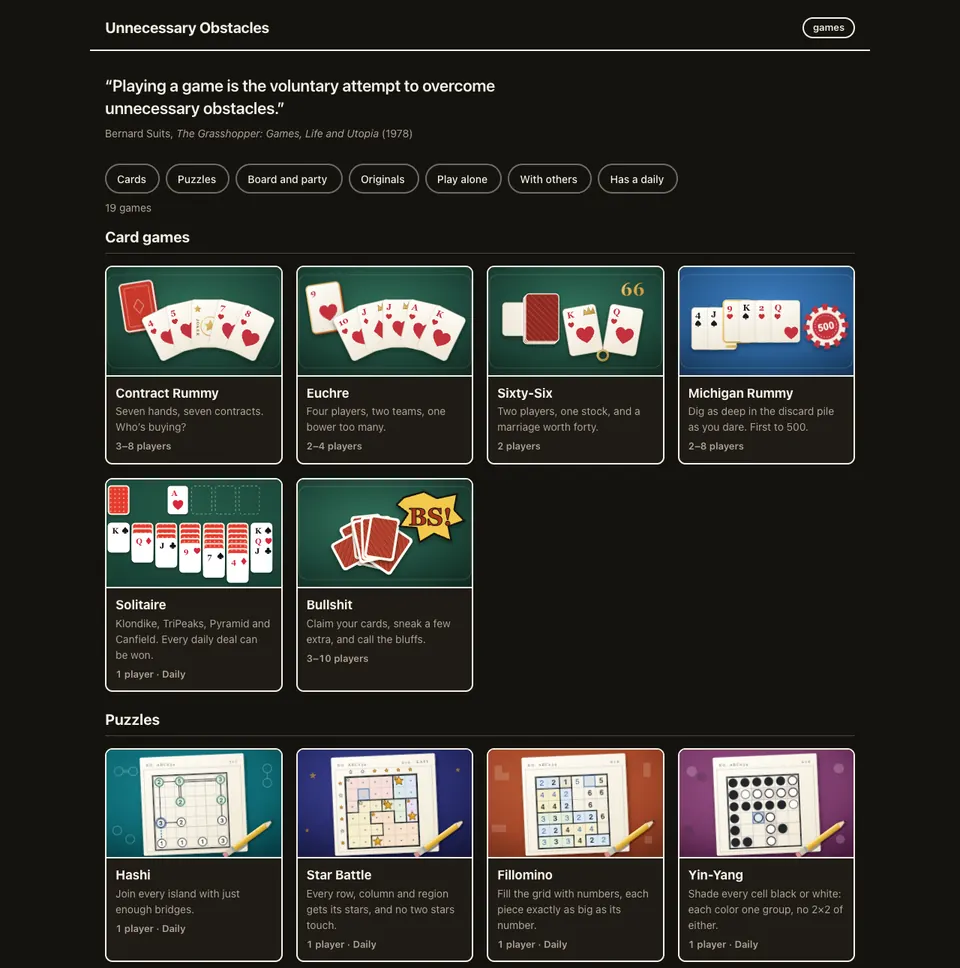
By October 13 the shelf had more than a dozen games, built in batches, and each had grown its own way of doing the same things. “A card game should feel like a UO card game no matter what,” I wrote (October 12). Each game could keep its personality, but never where it would break what a player expects.
Claude’s answer was structural: kits. The house kit holds the one sheet, result screen and motion every game shares (ADR 0025), the room kit draws every table (ADR 0015), and the puzzle kit puts every logic puzzle on the same paper (ADR 0023). A new game is mostly its rules and its board. Its personality goes where the kit leaves room: its palette, faces, board and art (Families and personality). Hashi gave up the nautical chart it started on, so it would read as part of the puzzle collection.
Built for a family that plays apart#
Asked how my family plays, I answered “mostly remote – let’s save the clunkier remote games (Taboo especially) for last” (October 11). So tables live on the server, anyone joins from a link, bots fill empty seats, and party games are held to the phone as firmly as the laptop (ADR 0014, ADR 0016).
One daily, not three#
Each puzzle started with three dailies. A week in, I’d found that “it’s overwhelming, it isn’t getting engagement (even from me, and I designed the thing!)” (October 18). Now every puzzle has one daily, on one Dailies page with your streaks (ADR 0034), and every daily follows the week, gentlest on Monday and hardest on Sunday (ADR 0041).
A guide that explains itself#
I wanted a technical guide on the site, for curious players like me, and asked Claude to “build in a mechanism that enforces updates to that documentation every time the code changes” (October 19). Claude built this guide the same day: chapters that pull their code live, stamps that fail when the code moves on, and a hook that blocks a commit while a chapter is stale (ADR 0035, How this guide stays true). Of everything here, it’s the piece I’d keep if I could keep only one.
Paper, not night#
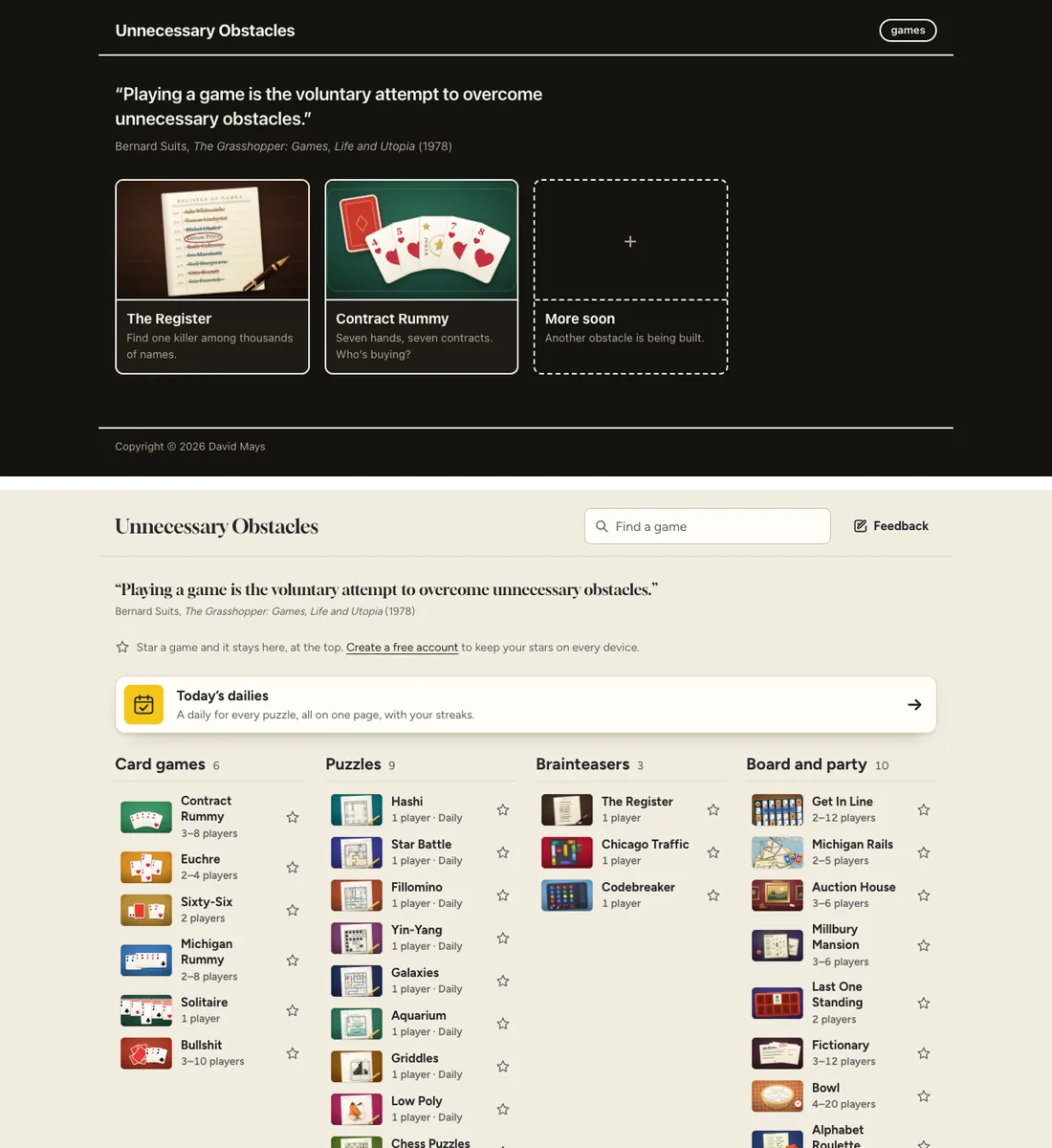
The hub started dark. “I think the dark mode is a little off-putting and not as welcoming as the paper style of the puzzles.” (October 22). The hub, this guide and the puzzles now share one paper, cream and graphite even at night (ADR 0036).
See it happen, don’t read about it#
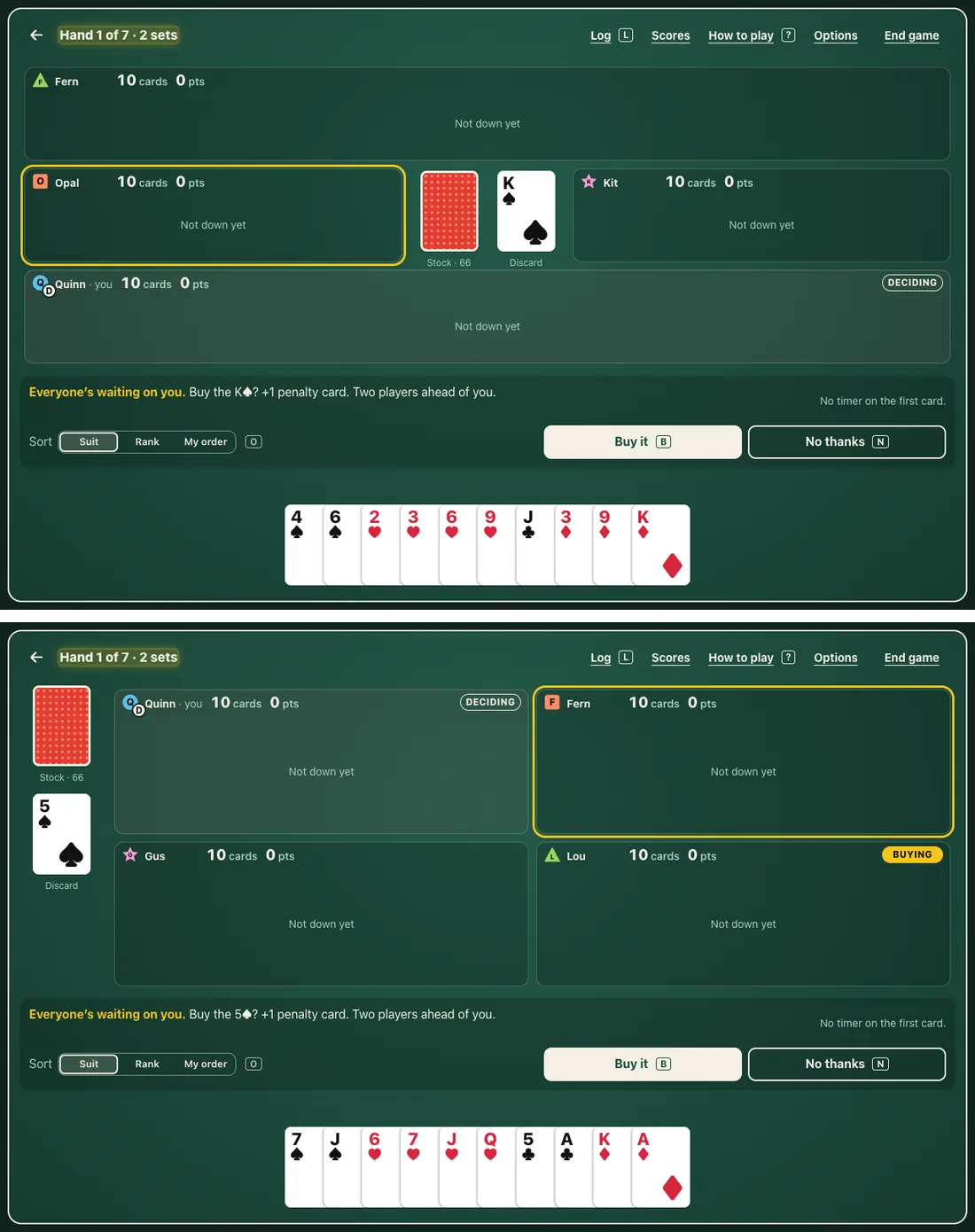
From the first game night I felt the log was doing a job the table should do: “anything that happens in the game log should probably have a clear visual indicator of happening anyway” (October 6). Michigan Rails, where it was hard to follow the board, settled it. The log moved out of the way, into the top bar (ADR 0046), and the table took over: cards that move where you can follow them, a band across the table for what’s done to you (ADR 0051), and the rule that big moments get a stage.
Simple, and hard to misclick#
On Michigan Rails’ turn buttons: “I want the UI to feel simple, the UX to feel intuitive, but also limit the opportunities for users to misclick by mistake.” (October 23). The buttons went, and you act on the board itself. The same day I’d had enough of each game’s rules popping up every time I opened it, so How to play now opens once per player, on any device they sign in from (ADR 0039).
A design system, not a pile of rules#
By October 30 the design rules had piled up one fix at a time, and Claude kept turning my latest complaint into the newest rule. I asked how to make one of them a broader principle instead of a specific opinion, and then for the whole thing: “I want the app to be developed within the context of a coherent design system.” (October 30).
Claude gathered every rule into the design system: each rule named once, under one of four words, and held by the kit, a check, or an audit by eye (ADR 0055). The four words are my October 7 list, tightened: human-first, ultra-readable, calm, delightful. “Retro” dropped out, and “delightful” came in.
Words anyone can read#
When the rulebooks were rewritten, the brief was mine: “I don’t want AI-speak, I want something anyone with a 5th grade reading level can understand and clearly interpret.” (November 7). Every game has one rulebook, the same words in the game and on its own page (ADR 0075, ADR 0078).
Delight, on purpose#
Planning version 2.0.0, I asked for “More focus on delight as a design feature.” (November 8). It’s in the release’s plan beside the new games: a Trophy Case, and celebrations for the moments worth one.
What a UO game is not#
Some things we tried and dropped, and some I turned down before they were built. They say as much about a UO game as the rules do.
- Not Claude’s own game ideas. Early on I asked Claude for original multiplayer games. It built several, and they worked, but they felt “a little bland and not that fun”. The site is the classics my family already loves, and Claude’s creativity goes into making those good. In November I dropped the parked originals for good.
- Not every house rule a setting. Sixty-Six’s first build made each rule an option. Now a rule is a table setting only when “some of us genuinely disagree about this one” (October 15); the rest are just the rules.
- Not overwhelming. A table’s setup form gave me “the feeling of visual overwhelm” (October 7). That led to the first house rules: one loud thing per view, and choices drawn quieter than actions (ADR 0012). Six daily cases in a row, and three dailies a puzzle, went the same way.
- Not the machinery’s numbers. The Register’s case report showed the generator’s statistics. It became a case file for players.
- Not a lesson before you play. Keyboard shortcuts first got a whole welcome screen. Now you discover them while you play: a game’s keys are printed on the buttons they press (Keys and focus).
- Not two ways to do one thing. Galaxies once let you paint a galaxy and lock it in, beside drawing its walls. Now you solve it with walls, and paint is only a note to yourself.
- Not janky or childish. The first box art looked “kind of janky and childish” (October 6). Every cover was redrawn to one style guide (
docs/box-art.md), and Last One Standing’s faces are drawn in one illustrated style instead of celebrities. - Not obviously made by a machine. Some Griddles pictures gave away that a program had drawn them, with odd lopsided bits (November 7). Now each picture is named blind and signed off before it’s dealt (ADR 0077).
- Not a social network, yet. “I’m not entirely sure I want to create more social networking elements on the site” (November 8). Friends lists wait for 3.0.0, if they come at all, and the release videos are cut for my family, not for social feeds.
- Not spam. “I never want to be known for spammy self-promotion” (October 25). We worked on being found in search instead (ADR 0048).
- Not tied to my other sites. This site has its own repository, database, domain and accounts, never shared with my personal website (ADR 0001).
- Not tracking. Counts stay in our own database with no cookies, and a player’s progress stays in their browser unless they sign in (ADR 0005,
AGENTS.mdrule 6).
Where it stands#
When I asked Claude for a video of version 1.0.0, I described what the whole system is built to do: “make and share games and puzzles I love, for free” (November 5). On November 8, 33 days in, that was 28 games on the shelf, about 1,500 commits (nearly all written with Claude), 81 decision records, more than 2,000 tests and nine releases. Those numbers are as of that day; the figures stay current.
npm run guide:timeline redraws it with the figure at the top, each count read from the tree as it stood at that point:
tools/guide/tally.py counts · lines 36–43# Each number: its name, and how it's counted in the tree at that point.
COUNTS = (
("Games on the shelf", "entries in games/catalog.py's GAMES, less any with listed=False"),
("Tests", "def test_ in a Python file, and test( or it( in a Node .test.mjs file"),
("Decisions (ADRs)", "docs/adr/<number>-*.md"),
("Guide chapters", "a chapter in docs/guide/ (not its README or known issues)"),
("Merged PRs", "merge commits of a pull request in the history so far"),
)
Version 2.0.0 is the first release run from a plan: a lead session keeps the plan, writes a brief for each piece of work, starts a session for it, and merges what passes. This part of the guide is one of those pieces.